Bidirectional charger with home backup single line diagram
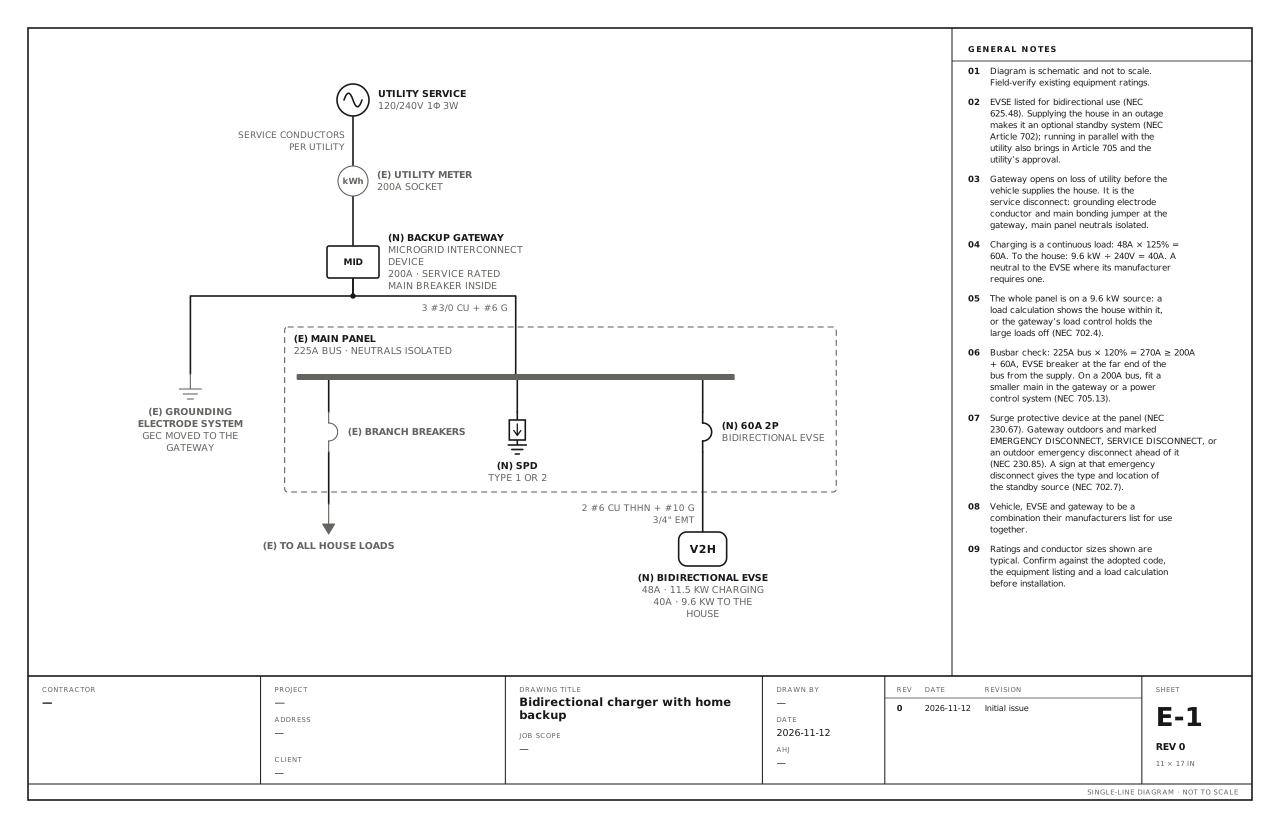
A vehicle-to-home charger behind a service-rated backup gateway that islands the house in an outage. Use this for a bidirectional charger that lets the vehicle run the house in an outage. A service-rated gateway ahead of the main panel separates the house from the grid before the vehicle supplies it.
A free template with typical ratings, conductor callouts and general notes. Open it, change what differs on your job, fill in the title block and export a PDF.
Open this template in the editor Download the SVG
What the reviewer checks on this drawing
The reviewer looks for a charger listed for bidirectional use, the gateway as the service disconnect with the panel neutrals isolated behind it, the busbar arithmetic, how the house load is kept within what the vehicle can supply, and the utility’s approval where the vehicle can run in parallel with the grid.
What the drawing shows
Every device on the sheet, in the order power reaches it.
| Symbol | Label | Rating or detail | Conductors feeding it |
|---|---|---|---|
| Utility source | Utility service | 120/240V 1φ 3W | |
| Meter | Utility meter | 200A socket | Service conductors, per utility |
| Device | Backup gateway (MID) | Microgrid interconnect device, 200A · service rated, main breaker inside | |
| Ground | Grounding electrode system | GEC moved to the gateway | |
| Panel | Main panel | 225A bus · neutrals isolated | 3 #3/0 Cu + #6 G |
| Circuit breaker | Branch breakers | ||
| To (continues off sheet) | To all house loads | ||
| Surge protective device | SPD | Type 1 or 2 | |
| Circuit breaker | 60A 2P | Bidirectional EVSE | |
| EV charger | Bidirectional EVSE | 48A · 11.5 kW charging, 40A · 9.6 kW to the house | 2 #6 Cu THHN + #10 G, 3/4" EMT |
Notes on the sheet
- EVSE listed for bidirectional use (NEC 625.48). Supplying the house in an outage makes it an optional standby system (NEC Article 702); running in parallel with the utility also brings in Article 705 and the utility’s approval.
- Gateway opens on loss of utility before the vehicle supplies the house. It is the service disconnect: grounding electrode conductor and main bonding jumper at the gateway, main panel neutrals isolated.
- Charging is a continuous load: 48A × 125% = 60A. To the house: 9.6 kW ÷ 240V = 40A. A neutral to the EVSE where its manufacturer requires one.
- The whole panel is on a 9.6 kW source: a load calculation shows the house within it, or the gateway’s load control holds the large loads off (NEC 702.4).
- Busbar check: 225A bus × 120% = 270A ≥ 200A + 60A, EVSE breaker at the far end of the bus from the supply. On a 200A bus, fit a smaller main in the gateway or a power control system (NEC 705.13).
- Surge protective device at the panel (NEC 230.67). Gateway outdoors and marked EMERGENCY DISCONNECT, SERVICE DISCONNECT, or an outdoor emergency disconnect ahead of it (NEC 230.85). A sign at that emergency disconnect gives the type and location of the standby source (NEC 702.7).
- Vehicle, EVSE and gateway to be a combination their manufacturers list for use together.
Diagram is schematic and not to scale. Field-verify existing equipment ratings. Ratings and conductor sizes shown are typical. Confirm against the adopted code, the equipment listing and a load calculation before installation. Code references are to the 2023 NEC and the 2024 Canadian Electrical Code: see references and editions.
Related EV charger drawings
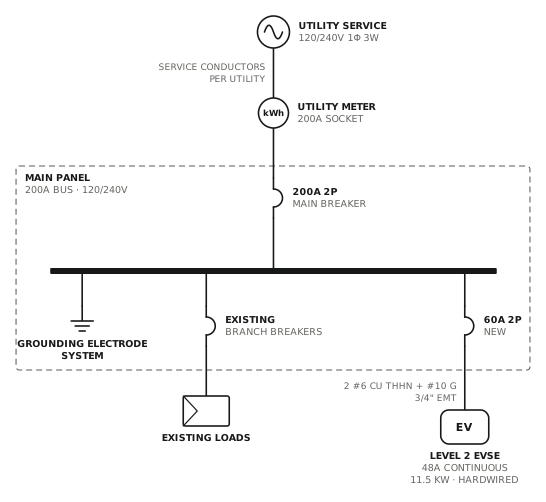
Level 2 charger from main panel
Dedicated 60A circuit to a hardwired 48A charger.
EVView drawing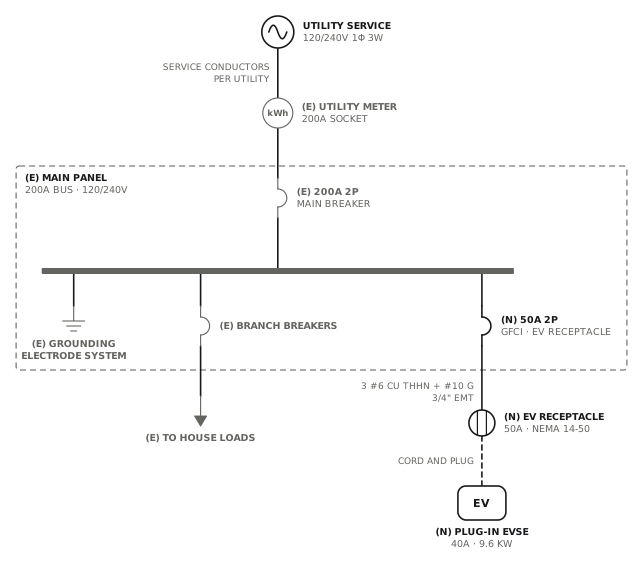
EV receptacle, NEMA 14-50
50A GFCI circuit to a 14-50 receptacle for a plug-in charger.
EVView drawing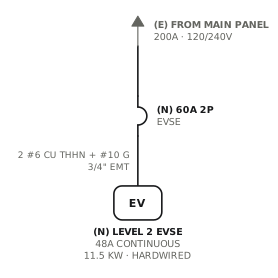
Level 2 charger, new work only
Only the new circuit, starting at an arrow from the main panel.
EVView drawing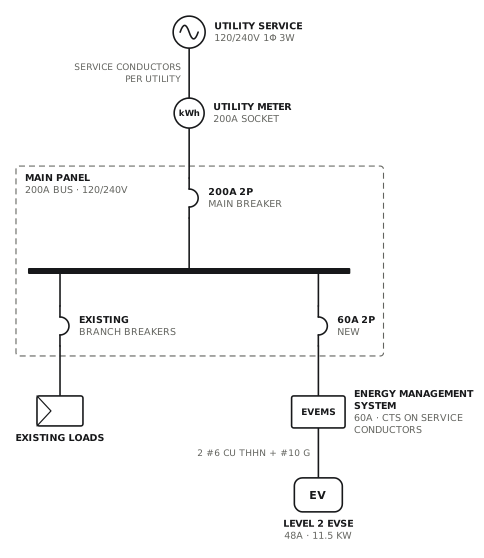
Level 2 charger with load management
Energy management system sheds the charger when the service is near its limit.
EVView drawingSee all EV charger single line diagrams, or all 80 templates.
Start from this drawing
Free, in the browser, no account. Start from a template or describe the job in plain words, edit the drawing and export a PDF.