Single line diagram symbols
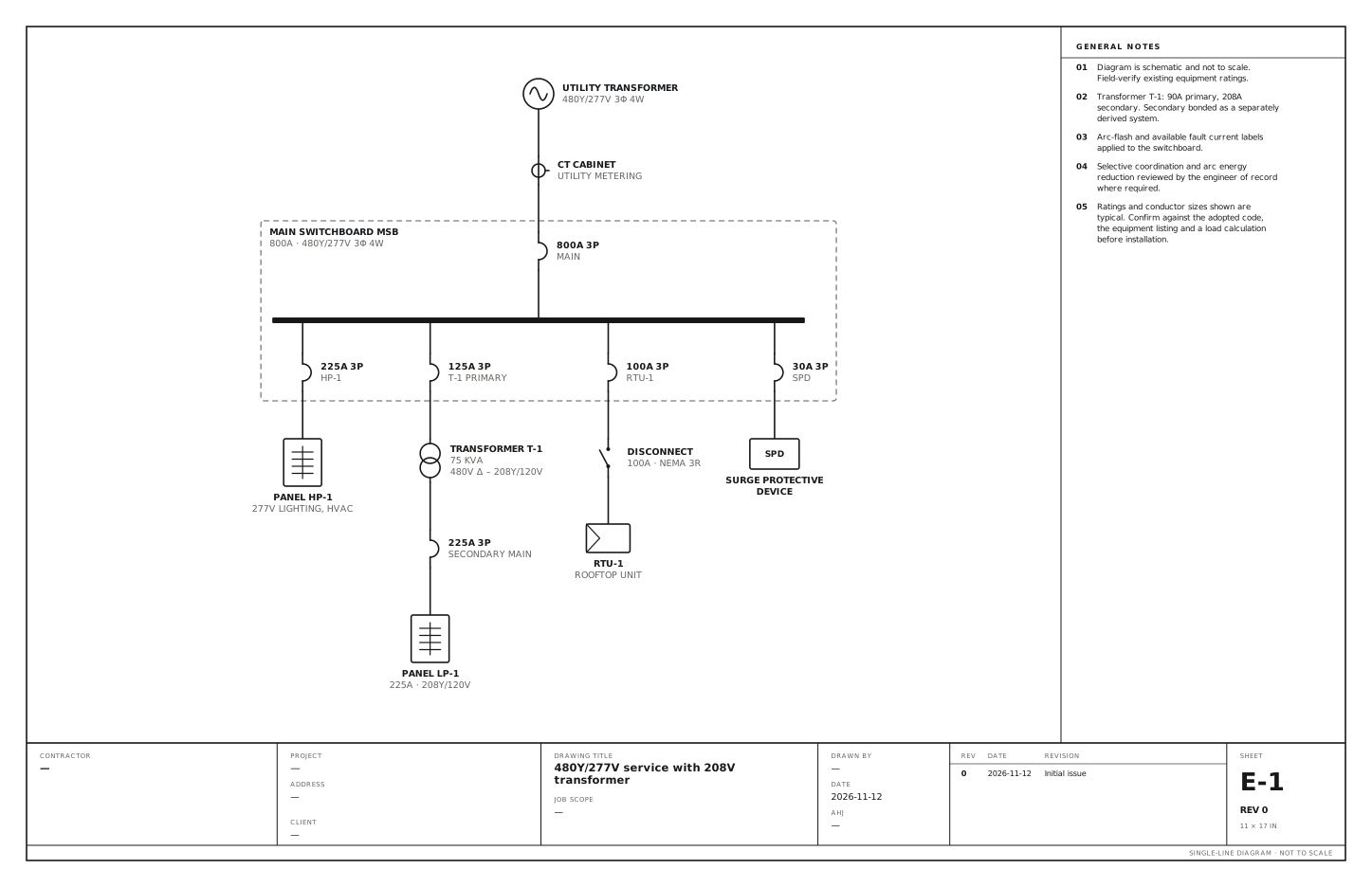
Single line diagram symbols are the standard shapes that stand for electrical equipment on a one-line drawing: a circle with a sine wave for the utility, an arc for a circuit breaker, two linked circles for a transformer, a heavy bar for a bus. This chart shows the 24 symbols used most on contractor drawings, what each one means and how it is labelled. All of them are in the Oneline symbol library.
Symbols differ a little between standards and between offices. North American drawings generally follow IEEE Std 315-1975 (also published as ANSI Y32.2 and CSA Z99; no longer actively maintained, but still the common reference), and international drawings follow IEC 60617. Whichever set you use, label every device with its rating and put a legend on the sheet if a symbol could be misread.
Sources
| Symbol | Name | What it means | How to label it |
|---|---|---|---|
| Utility source | A circle with a sine wave. The utility supply: the point where power enters the drawing. | Voltage, phases and wires, such as 120/240V 1φ 3W or 480Y/277V 3φ 4W. | |
| Generator | A circle with the letter G. A standby or portable generator. | kW or kVA and voltage, such as 22 kW · 120/240V. | |
| Transformer | Two linked circles, one for each winding. A transformer. Many North American drawings use two facing rows of scallops instead; both mean the same. | kVA and the primary and secondary voltages, such as 75 kVA, 480V to 208Y/120V. | |
| Power inlet | A circle with three prongs. A power inlet box for a portable generator cord. | Amp rating and plug configuration, such as 30A · L14-30. |
Protection
| Symbol | Name | What it means | How to label it |
|---|---|---|---|
| Circuit breaker | A line broken by an arc. A circuit breaker. | Amp rating and poles, such as 60A 2P. Add “Main” on the service disconnect. | |
| Disconnect switch | An open blade between two terminals. A disconnect switch with no fuses. | Amp rating and “non-fused”, such as 60A non-fused. | |
| Fused disconnect | An open blade in series with a fuse. A fused disconnect switch. | Switch rating and fuse size, such as 60A · 50A fuses. | |
| Fuse | A small rectangle on the line. A fuse. | Amp rating, and the fuse class where it matters. |
Distribution
| Symbol | Name | What it means | How to label it |
|---|---|---|---|
| Meter | A circle marked kWh (often just M). A revenue meter. | Socket rating, such as 200A socket, and the unit it serves on multi-unit drawings. | |
| Current transformer | A ring around the conductor with a lead coming off it. A current transformer, for metering or for an energy management system. | Ratio or purpose, such as Utility metering or EVEMS CTs. | |
| Bus bar | A heavy solid bar. A bus: the common conductor in a panel, switchboard or MCC that the breakers tap from. | Bus amp rating and voltage, such as 200A bus · 120/240V. | |
| Panelboard | A rectangle with rows of breakers. A panelboard drawn closed, when its individual breakers do not need to be shown. | Name and rating, such as Subpanel, 100A · 120/240V. | |
| Transfer switch | A box with a blade that swings between N (normal) and E (emergency). A transfer switch, which connects the load to either the utility or the generator, never both. | ATS (automatic) or MTS (manual), amp rating, and “service rated” where it is. | |
| Device | A rectangle with a short tag inside. Equipment without a symbol of its own: a gateway, an energy management system, a combiner, a drive or a UPS. | A tag inside the box, such as EVEMS, VFD or UPS, with the name and rating beside it. |
Loads
| Symbol | Name | What it means | How to label it |
|---|---|---|---|
| Load | A rectangle with an arrow notch. A load, or a group of loads, at the end of a circuit. | What it is, such as Existing loads, Site trailer or RTU-1. | |
| EV charger | A rounded rectangle marked EV. An electric vehicle charger (EVSE). | Amps and kW, such as 48A · 11.5 kW, and whether it is hardwired. | |
| Motor | A circle with the letter M. A motor. | Horsepower, such as 10 HP, and its equipment tag. | |
| Motor starter | A pair of contacts above an overload element. A motor starter: a contactor with overload protection. | Type and size, such as FVNR size 1. |
Solar and storage
| Symbol | Name | What it means | How to label it |
|---|---|---|---|
| PV array | A rectangle divided into cells. A photovoltaic array. | DC rating and module count, such as 8.0 kW DC, 20 × 400W. | |
| Inverter | A square split by a diagonal, with a DC mark on one side and a sine wave on the other. An inverter, which converts DC from the array or battery to AC. | AC rating, such as 7.6 kW, and its maximum output current. | |
| Battery | Alternating long and short plates. A battery or energy storage system. | Energy and power, such as 13.5 kWh. |
Annotation
| Symbol | Name | What it means | How to label it |
|---|---|---|---|
| Ground | Three stacked lines, each shorter than the one above. A connection to ground: the grounding electrode system. | The electrode and conductor, such as Ground rod, #6 Cu GEC. | |
| Enclosure | A dashed rectangle. An enclosure. Everything inside the box is in the same piece of equipment. | The equipment name and rating, such as Main panel, 200A bus. | |
| Text note | Plain lettering. A note placed on the drawing. | Anything the symbols cannot say: settings, clearances, who supplies what. |
Lines and wires
- A solid line is a power circuit: a service, a feeder or a branch circuit. The callout beside it gives the conductors and the raceway.
- A dashed line is a control, communication or cord-connected run, such as the lead from a current transformer to an energy management system.
- A dashed box is an enclosure, not a wire.
Abbreviations used on single line diagrams
| Abbreviation | Meaning |
|---|---|
| 1φ, 3φ | Single-phase, three-phase |
| 3W, 4W | Three-wire, four-wire |
| 2P, 3P | Two-pole, three-pole (breakers and switches) |
| A, kVA, kW, HP | Amperes, kilovolt-amperes, kilowatts, horsepower |
| AIC | Ampere interrupting capacity: the fault current a device can safely interrupt |
| ATS, MTS | Automatic transfer switch, manual transfer switch |
| CT | Current transformer |
| Cu, Al | Copper, aluminum conductors |
| EVSE | Electric vehicle supply equipment: the charger |
| EVEMS | Electric vehicle energy management system |
| ESS | Energy storage system |
| EMT, PVC | Common raceway types named in conductor callouts |
| FVNR | Full-voltage non-reversing (a motor starter type) |
| GEC | Grounding electrode conductor |
| MCA, MOCP | Minimum circuit ampacity, maximum overcurrent protection (HVAC nameplates) |
| MCC | Motor control centre |
| N, E | Normal and emergency sources on a transfer switch |
| PV | Photovoltaic (solar) |
| UPS | Uninterruptible power supply |
| VFD | Variable frequency drive |
Questions about symbols
What is the symbol for a circuit breaker on a single line diagram?
A line broken by a small arc, labelled with the amp rating and the number of poles, such as 60A 2P. Drawings to IEC standards use a line with a cross and an angled blade instead. Medium-voltage drawings often use a square.
What is the symbol for a transformer on a single line diagram?
Either two linked circles or two facing rows of scallops, one for each winding. It is labelled with the kVA rating and the primary and secondary voltages, such as 75 kVA, 480V to 208Y/120V.
What is the symbol for a disconnect switch?
An open blade drawn at an angle between two terminals. A fused disconnect adds a small rectangle, the fuse, in series with the blade. Label it with the switch rating and the fuse size.
Are single line diagram symbols standardized?
Yes, but more than one standard is in use. North American drawings generally follow IEEE Std 315-1975, also published as ANSI Y32.2 and CSA Z99. It is no longer actively maintained, but it is still the common reference. Most other countries follow IEC 60617. Offices and utilities add their own conventions, so a legend on the sheet is good practice.
Draw yours now
Every symbol in this chart is in the editor’s library. Drop one on the sheet, click it to set its label and rating, and pull a wire from one symbol to the next.